

Four weeknight recipes built around ingredients that support gut health, calm inflammatory skin conditions, and still taste like something your family will actually eat.
As biologic coordinators, we spend much of our day talking with patients about what their medications can do for them. But one conversation that doesn’t happen enough is what happens at the dinner table. Nobody is saying food replaces their biologic. That is not what this is. But for patients managing Crohn’s disease, psoriasis, eczema, or acne, chronic inflammation doesn’t clock out after their injection day. It lives in the gut, in the skin, in the immune system, around the clock. And what we eat either adds to that fire or helps put it out.
My grandma would so proud of me if she were alive to see this! My mother’s family and our history are deep-rooted in Louisiana, where food and flavors are layered and built on a foundation of spices that, as it turns out, carry some serious science behind them. Spending the last four years working toward my science degree pushed me to actually look that up. What I found is that many of these spices were medicine first and weren’t just about flavor. Turmeric was documented in Sanskrit medical texts as a treatment for digestive and skin conditions over 2,000 years ago. Garlic appears in the Ebers Papyrus as a treatment for 22 documented conditions. Cayenne and hot peppers were used by Indigenous peoples of the Americas for pain and circulation long before they made it into a cast-iron pot in Louisiana. Thyme was listed in official European pharmacopoeias as a legitimate medicine for centuries before it got reclassified as a culinary herb. The communities that built Louisiana’s food culture, West African, Indigenous, French, Spanish, and Caribbean, did not separate food from medicine the way modern culture does.
The space cabinet was the medicine cabinet. It still is.
These four recipes are weeknight realistic. They are designed for people who have been on their feet all day and still have to feed their families. Every one of them is dairy-free, and that is on purpose. Dairy is one of the first things that comes up when we talk about gut and skin flares, and I did not want it anywhere near this article. Every one of them can be prepped the night before so that coming home to a good meal is not a project; it is just dinner. And if any of your patients ask about anti-inflammatory dishes, please send them here. This one is for all of us.
A note on cooking with fat
Every recipe here uses extra virgin olive oil as the base cooking fat. Oleocanthal, the compound responsible for olive oil’s characteristic bite, works similarly to ibuprofen at the cellular level and is one of the most well-studied anti-inflammatory compounds in food science. Use it generously.
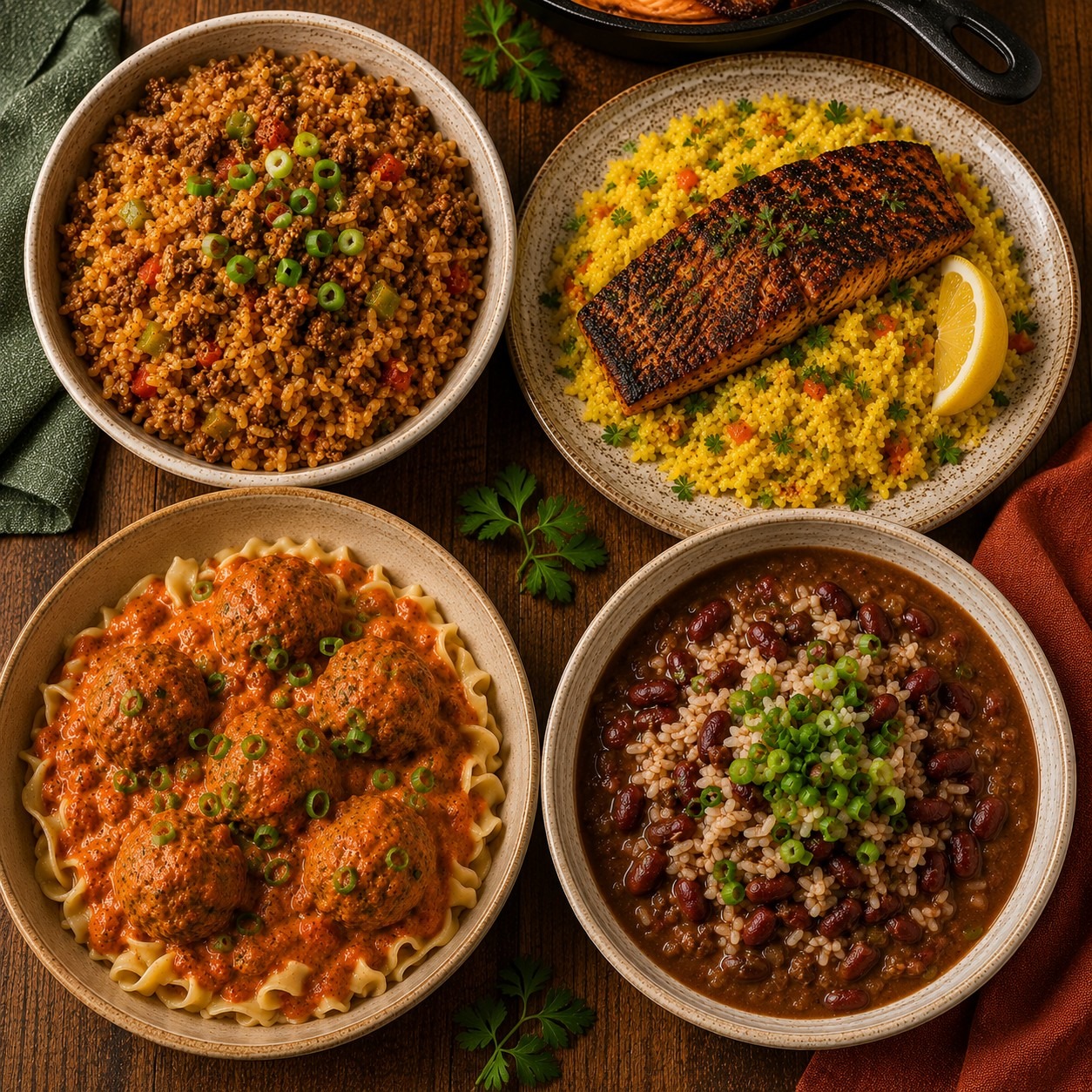
Four dairy-free recipes inspired by Creole cooking traditions.
Build your spice cabinet once. Use it forever.
You may not have all of these on hand right now. That is okay. These blends and individual spices are available at most grocery stores; they last a long time, and once you have them, you will reach for them constantly.
Tony Chachere’s
The Louisiana staple. Bold, versatile, goes on everything.
Slap Ya Mama
Slightly spicier profile. Great for blackening and marinades.
Dan-O’s
Lower sodium, herb, and citrus forward. The cleanest blend of the four.
Goya Adobo
Garlic forward all purpose seasoning. Use as your salt base.
Garlic powder
Use as an individual spice layer before reaching for a blend.
Onion powder
Builds depth without sodium. Layer it early in cooking.
A note on sodium: Tony’s, Slap Ya Mama, and Goya Adobo all carry significant sodium. Build your flavor foundation with individual spices first, then use the blends at the end to finish and adjust to taste. That is how good Cajun and Creole cooking works anyway.
BEFORE YOU COOK YOUR RICE, READ THIS
If any of the rice dishes in this article are going on your weekly meal prep list, cook your rice the day before. When rice is cooked and then cooled, the starch structure changes from a rapidly digestible carbohydrate into something called resistant starch. Resistant starch behaves more like fiber in the body. It slows glucose absorption, feeds the beneficial bacteria in your gut, and significantly reduces the blood sugar spikes that freshly cooked rice causes. For anyone managing diabetes, Crohn’s, or an inflammatory skin condition, that distinction matters.
Not all cooling methods are equal. Refrigerating your cooked rice overnight gives you a meaningful improvement over eating it fresh. But if you want the best result, freeze it. The rapid temperature drop from freezing causes a more dramatic conversion of the starch, giving you the highest resistant starch yield. Reheating does not undo it. The resistant starch stays intact either way. Cook it ahead. Your gut will know the difference.
The Recipes
WEEKNIGHT
Serves 4 | 45 min | Dairy free
WEEKNIGHT
Blackened meats, whether it was chicken, pork, or fish, were a huge part of growing up in my household. Turmeric, ginger, and black pepper together actually make each other work better in the body. Salmon brings the omega-3s that make this especially powerful for psoriasis and eczema.
Serves 4 | 35 min | Dairy free
KID FRIENDLY
Inspired by my grandmother, who made Creole meatballs in a rich, browned, cream-based sauce with that deep Caribbean Creole influence. I took what she made, played with it, and built something that keeps all of that soul without the dairy.
Serves 4 | 55 min | Dairy free
VEGETARIAN
Red Beans and Rice
Proof that you do not need meat to build flavor. The holy trinity, garlic, and Cajun spices do all the heavy lifting. Set your crockpot in the morning and come home to dinner already done.
Serves 4 | 6 to 8 hrs | Dairy free